 ebba.ossiannilsson
DIG COMP Community of Practice (COP) Ambassadors
I am honoured and delighted to share that I have been appointed by the CoP Coordination Team, which launched this initiative, to serve as a DigComp CoP Ambassador for Area 8: Regional and community-based digital inclusion. Nominations were made based on competence and experience profiles.
Her research explores how higher education can fulfil its public purpose through openness, quality, ethical leadership, lifelong learning, and trustworthy AI to advance human flourishing and sustainable futures.
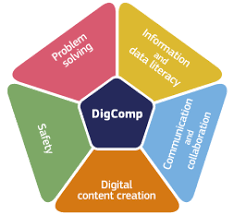
The European Digital Competence Framework (DigComp) is an official EU reference tool that defines the knowledge, skills, and attitudes people need to use digital technologies in a confident, critical, and responsible way. DigComp 3.0, which has intregrated AI, artificial intelligence, and is organizes digital competence into 5 core areas containing a total of 21 specific competencies
- Information and data literacy: Searching, filtering, evaluating, storing, and managing digital data and content.
- Communication and collaboration: Interacting online, sharing information, managing digital identity, and practicing netiquette.
- Digital content creation: Developing and editing content, applying copyrights and licenses, and programming.
- Safety: Protecting devices, personal data, privacy, physical and mental well-being, and the environment.
- Problem solving: Resolving technical issues, identifying digital needs, and using tech creatively.
Structure and Features
- AI Integration: Features the systematic and transversal integration of artificial intelligence knowledge across all 21 competencies.
- Proficiency Levels: Scales skills across granular or broad progression levels (from basic guided tasks up to highly advanced, specialized problem resolution).
- Use Cases: Used across Europe for education transparency, job profiles, self-assessments, and policy planning to support the EU Digital Decade goals.
The eight thematic areas for the DigComp COP Amassadors are:
- Higher education and Research
- School education and Youth work
- Vocational education, Adult learning, and Upskilling
- Business support and workplace digital competence / Employment, Career services, and Labour market inclusion (2 groups)
- Competence Certification, Assessment, and Credentialing
- Public Administration and Services
- Regional and Community-based digital inclusion
From my perspective as a DigComp COP Ambassador in the sector of Regional and Community-based digital inclusion, I will focus on active citizens in a global digital society in the era of AI. Within my research, networks, and projects, I will emphasise digital societies, active citizenship, inclusion, diversity, sustainability, scalability, seamless learning, learning on demand, and lifelong learning.
Share this
Blog archive
-
2026(20 articles)
- October 2026 (2 articles)
- September 2026 (5 articles)
- August 2026 (1 article)
- July 2026 (4 articles)
- June 2026 (3 articles)
- March 2026 (1 article)
- February 2026 (1 article)
- January 2026 (3 articles)
-
2025(4 articles)
- October 2025 (2 articles)
- September 2025 (1 article)
- January 2025 (1 article)
-
2024(5 articles)
- December 2024 (1 article)
- September 2024 (2 articles)
- June 2024 (1 article)
- February 2024 (1 article)
-
2023(12 articles)
- November 2023 (1 article)
- October 2023 (2 articles)
- May 2023 (1 article)
- April 2023 (4 articles)
- March 2023 (4 articles)
-
2022(18 articles)
- November 2022 (7 articles)
- September 2022 (1 article)
- August 2022 (1 article)
- July 2022 (2 articles)
- April 2022 (1 article)
- March 2022 (2 articles)
- February 2022 (3 articles)
- January 2022 (1 article)
-
2021(14 articles)
- December 2021 (10 articles)
- May 2021 (3 articles)
- February 2021 (1 article)
-
2020(25 articles)
- December 2020 (4 articles)
- July 2020 (4 articles)
- June 2020 (3 articles)
- May 2020 (4 articles)
- April 2020 (2 articles)
- March 2020 (4 articles)
- February 2020 (1 article)
- January 2020 (3 articles)
-
2019(29 articles)
- November 2019 (2 articles)
- October 2019 (1 article)
- July 2019 (2 articles)
- June 2019 (2 articles)
- April 2019 (2 articles)
- March 2019 (2 articles)
- February 2019 (3 articles)
- January 2019 (15 articles)
-
2018(29 articles)
- December 2018 (4 articles)
- November 2018 (6 articles)
- October 2018 (3 articles)
- June 2018 (3 articles)
- May 2018 (1 article)
- April 2018 (2 articles)
- March 2018 (3 articles)
- February 2018 (4 articles)
- January 2018 (3 articles)
-
2017(12 articles)
- December 2017 (4 articles)
- November 2017 (7 articles)
- October 2017 (1 article)