DigComp

AJOQI. Greenland - Teacher Education

I am so exited, and honored!

I have been invited to take part and contribute in a new interesting and exiting project with Greenland, and Ole Thorleifsen. The project aims to plan and start a teachers’ education for pedagogical untrained teachers in Greenland. These teachers are employed in the schools in Greenland, and many of them have been educators for years, and they have participated in numerous government/university arranged courses, but they haven’t obtained any certificate which gives them a status as a teacher with the benefits as a trained teacher. The goal with this prospect is to design a teachers’ education to these educators, so they can study two subjects besides pedagogy/didactics through three years and through their study, they have exams in the subjects and if they pass all the requirements in the curriculum, they can get a certificate as a trained teacher. The project is funded by Institute of Learning at the University of Greenland.

The project will be in three parts:

  • Distant education frame – will be designed in close collaboration with the municipal school administrations, Institute of learning and the Education Agency.
  • ICT framework and modify Open Educational Resources – the group is: Ebba Ossiannilsson, Lund, Sweden; Kati Clement, Jyäskylä, Finland; Jan Pawlowski, Essen, Germany, Thuridur Johannesdottir, University of Iceland, and Ole Thorleifsen, Nuuk, Greenland. The work will be assessed by a subject based clearinghouse with participants from the University of Greenland.
  • Curriculum -there will be established a group to write a curriculum for the education.

Information about the Greenlandic school system

The first discussion with the project team, took place in Copenhagen 26 February 2018. A fruitful and graet meeting with a very professional and enthusiastic team, led by Ole Thorleifsen. After information about the conditons and context, a lively discussion within the team took place. We were rather quick and efficient, mixed with a lot of fun and joy,  drawing up the schedule and the coming work within the project. I think we are the very best team to fulfil such interesting mission and tasks we have ahead. The first meeting in Greenland will be held in April 16-17 2018.

The Project became coined AJOQI, after the greenlandic word for the projects activities. 

Greenland (Greenlandic: Kalaallit Nunaat, pronounced [kalaːɬit nunaːt]; Danish: Grønland, pronounced [ˈɡʁɶnˌlanˀ]) is an autonomous constituent country within the Kingdom of Denmark between the Arctic and Atlantic Oceans, east of the Canadian Arctic Archipelago. Though physiographically a part of the continent of North America, Greenland has been politically and culturally associated with Europe (specifically Norway and Denmark, the colonial powers, as well as the nearby island of Iceland) for more than a millennium.[9] The majority of its residents are Inuit, whose ancestors began migrating from the Canadian mainland in the 13th century, gradually settling across the island. Greenland is the world's largest island.

DIG COMP Community of Practice (COP) Ambassadors

 I am honoured and delighted to share that I have been appointed by the CoP Coordination Team, which launched this initiative, to serve as a DigComp CoP Ambassador for Area 8: Regional and community-based digital inclusion. Nominations were made based on competence and experience profiles.

Ossiannilsson is a Professor in open education and innovation and open online learning, a senior expert and consultant, influencer, quality reviewer, and global expert in inclusive, scalable, and sustainable education, aligned with SDG4, the new social contract, and AI. She served on the ICDE Board for two terms, has contributed to several research projects with ICDE, its Technology and Innovation Network and Open Education Network, and chairs the Leadership through Uncertainty Committee. She is a former chair of the ICDE OER Advocacy Committee.

Ossiannilsson works with leading international organisations and authorities. She collaborates with OE4BW, ASEF7 Innolab, and U Novo Gorica, SL, on its Master’s course in Leadership in Open Education. She serves on editorial boards and is a frequent keynote speaker. She has published over 200 works in her field. She has received numerous awards, including ICDE honorary membership, Open Education Global’s Excellence in Open Leadership, SPARC Europe, and Open Education Europa.

In addition, she has actively contributed to almost all initiatives by the JRC, the Joint Research Centre, such as EntreComp, DigComp, DigCompEdu, and OpenED, where she already serves as an Ambassador. She was also the initiator of the Swedish translation of DigComp 2.2. Her research explores how higher education can fulfil its public purpose through openness, quality, ethical leadership, lifelong learning, and trusted AI to advance human flourishing and sustainable futures.

Her research explores how higher education can fulfil its public purpose through openness, quality, ethical leadership, lifelong learning, and trustworthy AI to advance human flourishing and sustainable futures.

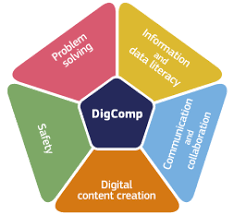
The European Digital Competence Framework (DigComp) is an official EU reference tool that defines the knowledge, skills, and attitudes people need to use digital technologies in a confident, critical, and responsible way. DigComp 3.0, which has intregrated AI, artificial intelligence, and is organizes digital competence into 5 core areas containing a total of 21 specific competencies
    • Information and data literacy: Searching, filtering, evaluating, storing, and managing digital data and content.
      • Communication and collaboration: Interacting online, sharing information, managing digital identity, and practicing netiquette. 
        • Digital content creation: Developing and editing content, applying copyrights and licenses, and programming. 
          • Safety: Protecting devices, personal data, privacy, physical and mental well-being, and the environment.
            • Problem solving: Resolving technical issues, identifying digital needs, and using tech creatively. 

            Unknown

              Structure and Features
                • AI Integration: Features the systematic and transversal integration of artificial intelligence knowledge across all 21 competencies. 
                  • Proficiency Levels: Scales skills across granular or broad progression levels (from basic guided tasks up to highly advanced, specialized problem resolution). 
                    • Use Cases: Used across Europe for education transparency, job profiles, self-assessments, and policy planning to support the EU Digital Decade goals.

                    The eight thematic areas for the DigComp COP Amassadors are: 

                    • Higher education and Research
                    • School education and Youth work
                    • Vocational education, Adult learning, and Upskilling
                    • Business support and workplace digital competence / Employment, Career services, and Labour market inclusion (2 groups)
                    • Competence Certification, Assessment, and Credentialing
                    • Public Administration and Services
                    • Regional and Community-based digital inclusion
                    From my perspective as a DigComp COP Ambassador in the sector of Regional and Community-based digital inclusion, I will focus on active citizens in a global digital society in the era of AI. Within my research, networks, and projects, I will emphasise digital societies, active citizenship, inclusion, diversity, sustainability, scalability, seamless learning, learning on demand, and lifelong learning.


                    Mind the gap

                    Educational institutions  are facing many challenges ahead. To be in the forefront, which is one of the mainroles for unviversities, both when it comes to teaching, learning, and research, but also to be a voice in the global soceiety, universitites more than ever have to be on the cutting edge, and to take the lead for the UNESCO SDG4. The leading actions are on ACCESS, EQUITY, EQUALITY, DEMOCRACY, INCLUSIVENESS, QUALITY, AND LIFELONG AND LIFEWIDE LEARNIG, 

                    In additon, we are facing and have to adapt, but also to lead the 4th Indsutrial Revolution, and the digital disruption.

                    We stand on the brink of a technological revolution that will fundamentally alter the way we live, work, and relate to one another. In its scale, scope, and complexity, the transformation will be unlike anything humankind has experienced before. We do not yet know just how it will unfold, but one thing is clear: the response to it must be integrated and comprehensive, involving all stakeholders of the global polity, from the public and private sectors to academia and civil society.

                    There are three reasons why today’s transformations represent not merely a prolongation of the Third Industrial Revolution but rather the arrival of a Fourth and distinct one: velocity, scope, and systems impact. The speed of current breakthroughs has no historical precedent. When compared with previous industrial revolutions, the Fourth is evolving at an exponential rather than a linear pace. Moreover, it is disrupting almost every industry in every country. And the breadth and depth of these changes herald the transformation of entire systems of production, management, and governance.


                    The European competence framework: The LifeComp (JRC)

                    In our rapidly changing societies, citizens need to develop competences which allow them to successfully manage the challenges posed by the many transitions taking place in their work, in their personal spheres, and in society (JRC, 2020).

                    The 22 July 2020, an important and timely framework was launched by the European Commission’s Joint Research Center (JRC), the LifeComp, the European competence framework on Personal, Social and Learning to Learn.  JRC has developed several competence frameworks, the "Comp" family by #DigComp, #DigCompEdu, #DigCompOrg, #SELFIE,#Entrecomp, and now, #LifeComp.

                    Maybe, one of the previous most wellknown one is the DigComp 2.0 framework, which identifies the key components of digital competence in 5 areas which can be summarized as:1) Information and data literacy, 2) Communication and collaboration, 3) Digital content creation, 4) Safety, and 5) Problem solving, and problably also #SELFIE

                    This framework is really welcomed and I really hope It will be implemented and in use for Education and training. Its really urgent to change perspectives and to transform Education into these directions.


                    The Joint Research Centre (JRC) developed the LifeComp framework on behalf of, and in collaboration with the Directorate-General for Education, Youth, Sport, and Culture (DG EAC). This is the third competence framework for individuals the JRC has contributed to develop, following the already consolidated Digital Competence Framework for Citizens, also known as DigComp, and the Entrepreneurship Competence Framework, EntreComp. JRC believe that LifeComp is a crucial complement to these and other frameworks, and maybe even constitutes the base line, as it deals with life skills – the skills and competences that everybody should continually develop throughout life. The LifeComp framework is a conceptual reference framework; more work will be needed to put the framework into practice, and to guide stakeholders on its implementation. 

                    The JRC report is part of their research on ‘Learning and Skills for the Digital Era’. Since 2005, more than 25 major studies have been undertaken in this area, resulting in more than 120 publications. More information on all of our studies can be found on the JRC Science hub

                    As according to the researchers LifeComp competences are teachable. They can be learned through formal or informal education.

                    "It is possible to teach a person to be a critical thinker, to control their emotions or to become more empathetic towards others. These skills are fundamental for people to be able to determine their own career paths and for their own well-being"

                    The researchers thus hope that the formalization of the skills into a framework will encourage schools and teachers to devote more time for them in the learning programmes.

                    The LifeComp framework is well aligned with the UNESCO initiative Futures of Education: Learning to become, which goes beyond  the UNESCO SDGs and education for all, and targeting for education 2050. The Initiatives rethinks how knowledge and learning can shape the future of humanity and the planet. The Futures of education initiative goes beyond the SDG and target for Education 2050. This initiative aims to rethink education and shape the future. The initiative catalyzes a global debate on how knowledge, education and learning must be rethought in a world of increasing complexity, uncertainty and precariousness.

                    Overview of the LifeComp framework

                    The LifeComp framework is a flexible tool that can be adapted to different learning settings, and target groups to support the development of the Personal, Social and Learning to Learn competences in a sociocultural context. Both formal, non-formal, and informal education can contribute to the acquisition of these competences.

                    As a rule, the definition of "competence" includes knowledge, skills and attitudes. However, a holistic perspective that understands the interdependence between the elements of the framework as a complex ecosystem can be more effective. Indeed, the key competence comprises elements with different profiles and characteristics. For example, some focus on attitudes as dispositions and orientations for action; others represent a range of competences. 

                    To cope with a given situation, individuals activate a range of competences that vary according to the requirements of the situation. All the competences included in the framework are therefore equally relevant, necessary, interrelated and interconnected and should be treated as parts of a whole.

                    Based on this framework, these are the nine skills that can help people of all ages to manage the challenges and changes in their personal and professional lives. 

                    The Personal domain includes 

                    1. Self-regulation: Awareness and management of emotions, thoughts and behaviour
                    2. Flexibility: Ability to manage transitions and uncertainty, and to face challenges
                    3. Wellbeing: Pursuit of life satisfaction, care of physical, mental and social health, and adoption of a sustainable lifestyle

                    The Social domain includes:

                    1. Empathy: The understanding of another person’s emotions, experiences and values, and the provision of appropriate responses
                    2. Communication: Use of relevant communication strategies, domain-specific codes and tools depending on the context and the content
                    3. Collaboration: Engagement in group activity and teamwork acknowledging and respecting others

                    The Learning to learn domain includes:

                    1. Growth mindset: Belief in one’s and others’ potential to continuously learn and progress
                    2. Critical thinking: Assessment of information and arguments to support reasoned conclusions and develop innovative solutions
                    3. Managing learning: The planning, organizing, monitoring and reviewing of one's own learning

                    The LifeComp framework emphasizes the importance of social and personal skills. It aims to systemize the strengthening of these competences through education and lifelong learning.

                    The domains are shown in Table 2, and as a visualized metaphor as a glance as in Figure 5, and as the LifeComp Ecosystem in Figure 6. It is important to take a holistic approach and to see the ecosystem of the LifeComp,

                    Source: Sala, A., Punie, Y., Garkov, V. and Cabrera Giraldez, M., LifeComp: The European Framework for Personal, Social and Learning to Learn Key Competence, EUR 30246 EN, Publications Office of the European Union, Luxembourg, 2020, ISBN 978-92-76-19418-7 (online),978-92-76-19417-0 (print), doi:10.2760/302967 (online),10.2760/922681 (print), JRC120911

                    A Blogpost on this theme has been published 26 July 2020 at the DISK project Blog, as this project deals with Digital comptences and Digital Survival Kit for Digital Immigrants.

                    UNESCO Mobile Learning Week 2018

                    Mobile Learning Week is UNESCO’s flagship ICT in education conference. Mobile Learning Week 2018 is organized in partnership with the International Telecommunication Union (ITU), the United Nations specialized agency for ICT. The event was held from 26 to 30 March 2018, at UNESCO Headquarters in Paris. The 2018 event was organized under the theme “Skills for a connected world”. Participants will exchange knowledge about the ways governments and other stakeholders can define and achieve the skills-related targets specified by Sustainable Development Goal 4 (SDG 4).

                    The conference, consisted of four related sub-events, whch aimed to facilitate actions to:

                    Defining and mainstreaming digital skills;
                    Innovating skills provision for jobs in the digital economy;
                    Closing inequalities and gender divides; and
                    Mapping and anticipating changing skill needs

                    The MLW 2018 gathered participants from all over the world, and approxiamtely over 100 countries. During the week Workshops, Symosium, Policy Forum, and Strategy Labs were held. Of special interest, in my opinin was the Policy Forum, which offered a platform to discuss the different pathways that governments are using to support the development of the digital skills required in the digital economy.  Moblie learning was of course emphasized as the only way forwar to reach the UNESCO SDG4. However, there are still huge gaps around the worls on the leading  highlighted SDG€ themes on  access, equity, equality, inclusiveness, lifelong and lifewide learning, and quality.  In addition, there are even huges gaps around the world when it comes to digital competences, for iife and for education.

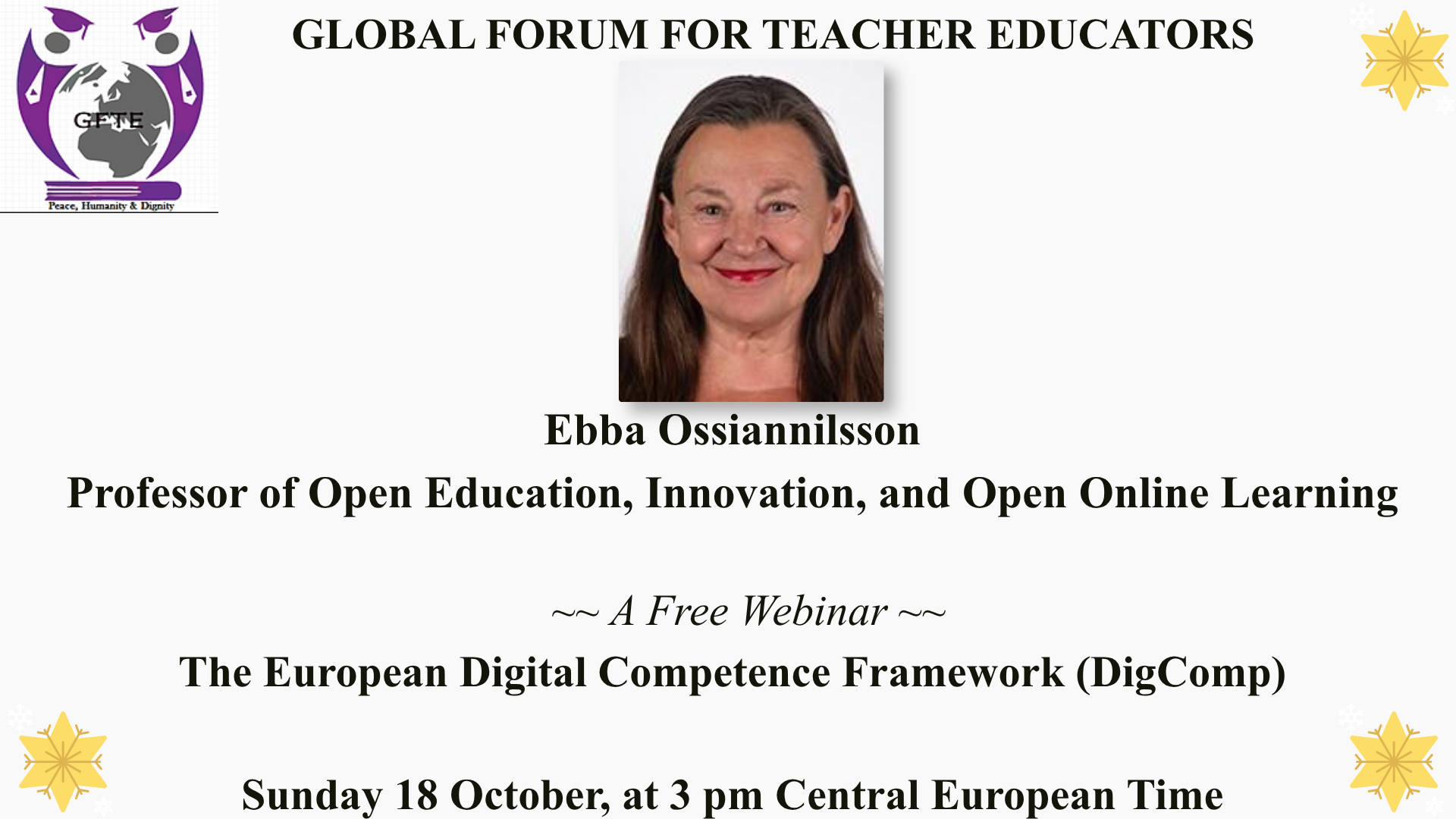
                    Webinar on the European Digital Competence Framework and its Use for Global Teachers' GFTE

                     
                    I am honoured and proud to have been invited to host a webinar on the European Digital Competence Framework and its use for global teachers at the Global Forum for Teacher Educators (GFTE).


                    GFTE is a global platform for Asian, European, and international educators, launched by Dr @Munir to support free knowledge and skills development. GFTE is not an institution; it is a virtual forum and a community of teachers who believe in sharing knowledge at no cost. GFTE is a free forum with members from more than 75 countries across Asia, Europe and beyond.
                     
                    Time 18 October, 2026, 3PM CEST
                    The European Digital Competence Framework (DigComp) is an official EU reference tool that defines the knowledge, skills, and attitudes people need to use digital technologies in a confident, critical, and responsible way. DigComp 3.0, which has integrated AI, artificial intelligence, and organizes digital competence into 5 core areas containing a total of 21 specific competencies
                    • Information and data literacy: Searching, filtering, evaluating, storing, and managing digital data and content.
                      • Communication and collaboration: Interacting online, sharing information, managing digital identity, and practicing netiquette. 
                        • Digital content creation: Developing and editing content, applying copyrights and licenses, and programming. 
                          • Safety: Protecting devices, personal data, privacy, physical and mental well-being, and the environment.
                            • Problem solving: Resolving technical issues, identifying digital needs, and using tech creatively. 

                            Unknown

                              Structure and Features
                                • AI Integration: Features the systematic and transversal integration of artificial intelligence knowledge across all 21 competencies. 
                                  • Proficiency Levels: Scales skills across granular or broad progression levels (from basic guided tasks up to highly advanced, specialized problem resolution). 
                                    • Use Cases: Used across Europe for education transparency, job profiles, self-assessments, and policy planning to support the EU Digital Decade goals.

                                     I am honoured and delighted that I have been appointed by the CoP Coordination Team, which launched this initiative, to serve as a DigComp CoP Ambassador for Area 8: Regional and community-based digital inclusion. Nominations were made based on competence and experience profiles.

                                    The eight thematic areas for the DigComp COP Amassadors are: 

                                    • Higher education and Research
                                    • School education and Youth work
                                    • Vocational education, Adult learning, and Upskilling
                                    • Business support and workplace digital competence / Employment, Career services, and Labour market inclusion (2 groups)
                                    • Competence Certification, Assessment, and Credentialing
                                    • Public Administration and Services
                                    • Regional and Community-based digital inclusion