 ebba.ossiannilsson
NVL conference in Klaksvik Faroe Island 16-19 September 2024
From September 16-19, 2024, the Network for Adult Learners (Nätverket för vuxnas lärande, NVL) for the Nordic Council of Ministers held its conference in Klaksvik in the Faroe Islands. The Nordic Council of Ministers is the official body for intergovernmental cooperation in the Nordic region. The vision of the Prime Ministers is that the Nordic region will be the most sustainable and integrated in the world by 2030. Cooperation in the Nordic Council of Ministers must serve this goal.

All Nordic countries were represented at this NVL conference in Klaksvik, FO, including the independent Åland Islands, the Faroe Islands, and Greenland. Around 100 delegates discussed the topics of adult education, digital inclusion, validation, and study guidance, as well as the overarching theme of lifelong learning. The first day on September 16 was a working day on the topics of digital inclusion, validation, and study guidance of the represented NVL network. On the second day, September 17, Djoni N. Joensen, Minister for Children and Education, gave a welcoming speech on the importance of Nordic cooperation and education as well as on the topics of adult education, digital inclusion, validation and study guidance, and the overarching theme of lifelong learning in our committees. In the welcoming speech by the main coordinator of the Network for Adult Learners (Nätverket för vuxnas lärande, NVL) Antra Carlsen addressed the changes that the NVL will make shortly and to achieve the Nordic Agenda for 2030. First of all, the name will change to the Lifelong Learning Network and the target group will explicitly include policymakers, governments, and strategy levels
The network Digital Inclusion I am part of, co-ordinated by Johanni Larjanko held a workshop during this conference on our work, developed digital inclusion toolkits, and developed future perspectives for digital inclusion and accessibility for as many people as possible to leave no one behind in an increasingly digital society and world. The network is working to bridge the digital divide and improve adults' understanding of digital participation. By supporting working solutions in adult education and making recommendations to policymakers, the network helps to ensure that the adult population in the Nordics has better opportunities to use digital community services, participate in lifelong learning, become active and critical citizens and users of technology, and be better able to cope with increasingly digital working life.
The toolkit is designed to facilitate conversations between educators and citizens, the toolkit helps identify the exact challenges individuals face as they navigate the digital landscape.
“This personalized approach allows for tailored support that facilitates access to digital tools and reduces anxiety for users. It recognizes that the barriers to digital literacy are not only technical but often psychological and social”," explained Emil Schriver from the NVL during his presentation.
“These barriers can include a lack of self-confidence, fear of making mistakes, and limited experience of digital environments. – NVL’s digital toolkit not only helps with the development of digital skills but also with social inclusion”
As citizens become more comfortable and proficient with digital tools, they are better able to participate in the digital economy, access online services, and connect with wider social networks.
Are you working with digital support and guidance? Then NVL’s Digital Toolkit is for you.
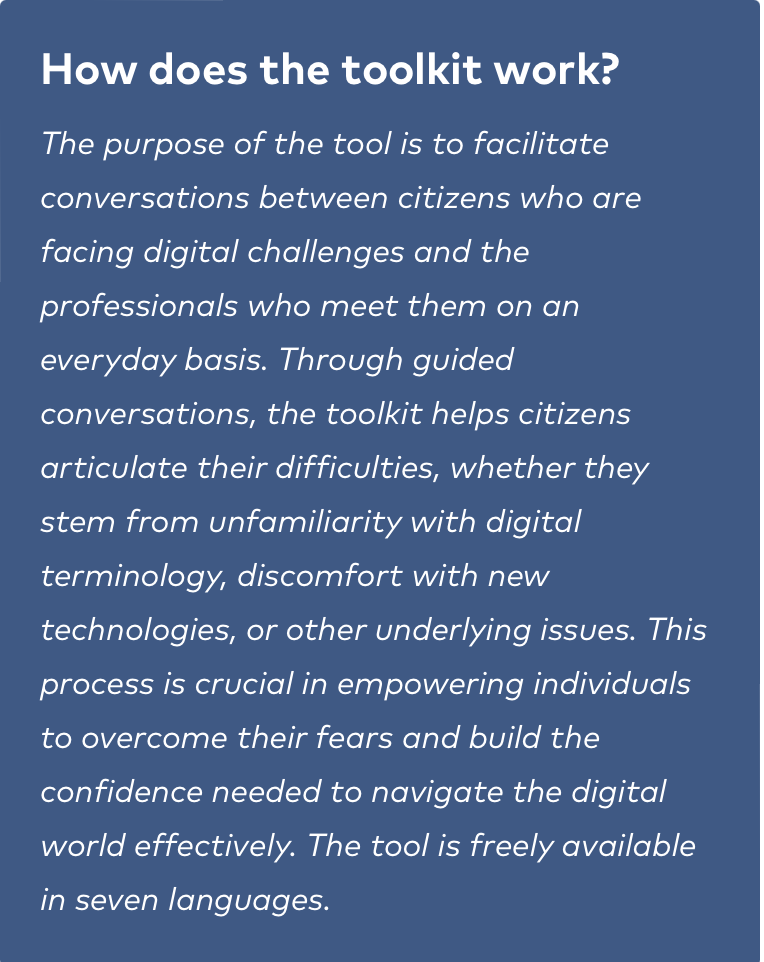
The purpose of the tool is to facilitate a conversation between citizens who are facing digital challenges and the professionals who meet them on an everyday basis.
Conversation Tool
The conversation helps the citizen in explaining and understanding what feels challenging in the digital world.
The tool serves as a starting point for further discussions about the type of assistance needed and what the next step is. The conversation tool consists of five different thematic sets of questions and is based on research findings. You can use one, several, or all themes in your work.
Relationship circle
The Relationship Circle is a tool you can use to map out the various relationships and support you, as a citizen, may need when interacting with digital systems and the digital world in general.
The type of relationship and support an individual needs can vary greatly, and time and place also play a role. The tool takes into account that needs can be very different and hopefully shows a way forward in dealing with the digital.
The Relationship Circle can be used as an independent tool or together with the Conversation Tool.
During the annual conference in Valladolid, Spain, on June 27 and 28, 2024, of the European Basic Skills Network (EBSN), which focused on ‘Upskilling and Reskilling for the Twin Transition: Digital and Green Transformation’ the Nordic At the EBSN conference on June 27-28, 2024, where the Nordic Network for Adult Learning (NVL) presented the toolkit, Alex Stevenson, Deputy Director of the Learning and Work Institute, UK, and member of the EBSN Executive Committee, explained in an interview that the NVL’s newly developed digital toolkit is a resource aimed at identifying and removing specific barriers that prevent citizens from using IT solutions effectively. The toolkit is an important step in promoting digital literacy, an essential skill in today’s increasingly digital world. Stevenson welcomes the toolkit’s potential impact and relevance.
“The NVL Digital Toolkit is well-conceived, as it addresses both the topical nature of digital skills and the practical use by intermediaries,” Stevenson says and points out that perhaps there is less stigma associated with gaining digital skills compared to literacy skills making the toolkit a good starting point for engaging adults about their skills needs.
“Secondly, the focus on use by intermediaries is also very encouraging. Our work in the UK has shown the potential for such a tool to be used in a range of public services contexts, from job centres, libraries, health services and social housing, to identify people who might benefit from improving their skills”
Flexibility is exactly one of the ideas behind the development of the digital toolkit. Being both flexible and user-friendly, the toolkit is designed to be used in many different contexts and situations.
Read more about the importance of visuals in digital learning in this article published by the European Lifelong Learning Magazine.
Read more here https://nvl.org/artikler/nvl-showcases-innovative-digital-toolkit-at-european-basic-skills-network-annual-conference-2024/
Share this
Blog archive
-
2026(20 articles)
- October 2026 (2 articles)
- September 2026 (5 articles)
- August 2026 (1 article)
- July 2026 (4 articles)
- June 2026 (3 articles)
- March 2026 (1 article)
- February 2026 (1 article)
- January 2026 (3 articles)
-
2025(4 articles)
- October 2025 (2 articles)
- September 2025 (1 article)
- January 2025 (1 article)
-
2024(5 articles)
- December 2024 (1 article)
- September 2024 (2 articles)
- June 2024 (1 article)
- February 2024 (1 article)
-
2023(12 articles)
- November 2023 (1 article)
- October 2023 (2 articles)
- May 2023 (1 article)
- April 2023 (4 articles)
- March 2023 (4 articles)
-
2022(18 articles)
- November 2022 (7 articles)
- September 2022 (1 article)
- August 2022 (1 article)
- July 2022 (2 articles)
- April 2022 (1 article)
- March 2022 (2 articles)
- February 2022 (3 articles)
- January 2022 (1 article)
-
2021(14 articles)
- December 2021 (10 articles)
- May 2021 (3 articles)
- February 2021 (1 article)
-
2020(25 articles)
- December 2020 (4 articles)
- July 2020 (4 articles)
- June 2020 (3 articles)
- May 2020 (4 articles)
- April 2020 (2 articles)
- March 2020 (4 articles)
- February 2020 (1 article)
- January 2020 (3 articles)
-
2019(29 articles)
- November 2019 (2 articles)
- October 2019 (1 article)
- July 2019 (2 articles)
- June 2019 (2 articles)
- April 2019 (2 articles)
- March 2019 (2 articles)
- February 2019 (3 articles)
- January 2019 (15 articles)
-
2018(29 articles)
- December 2018 (4 articles)
- November 2018 (6 articles)
- October 2018 (3 articles)
- June 2018 (3 articles)
- May 2018 (1 article)
- April 2018 (2 articles)
- March 2018 (3 articles)
- February 2018 (4 articles)
- January 2018 (3 articles)
-
2017(12 articles)
- December 2017 (4 articles)
- November 2017 (7 articles)
- October 2017 (1 article)